Quick Answer
Stamped concrete in Houston, TX costs $8 to $25 per square foot installed in 2026. The average stamped concrete patio project costs about $4,461, with most Houston homeowners spending between $2,778 and $6,144 — roughly half the installed cost of natural stone for a similar look.
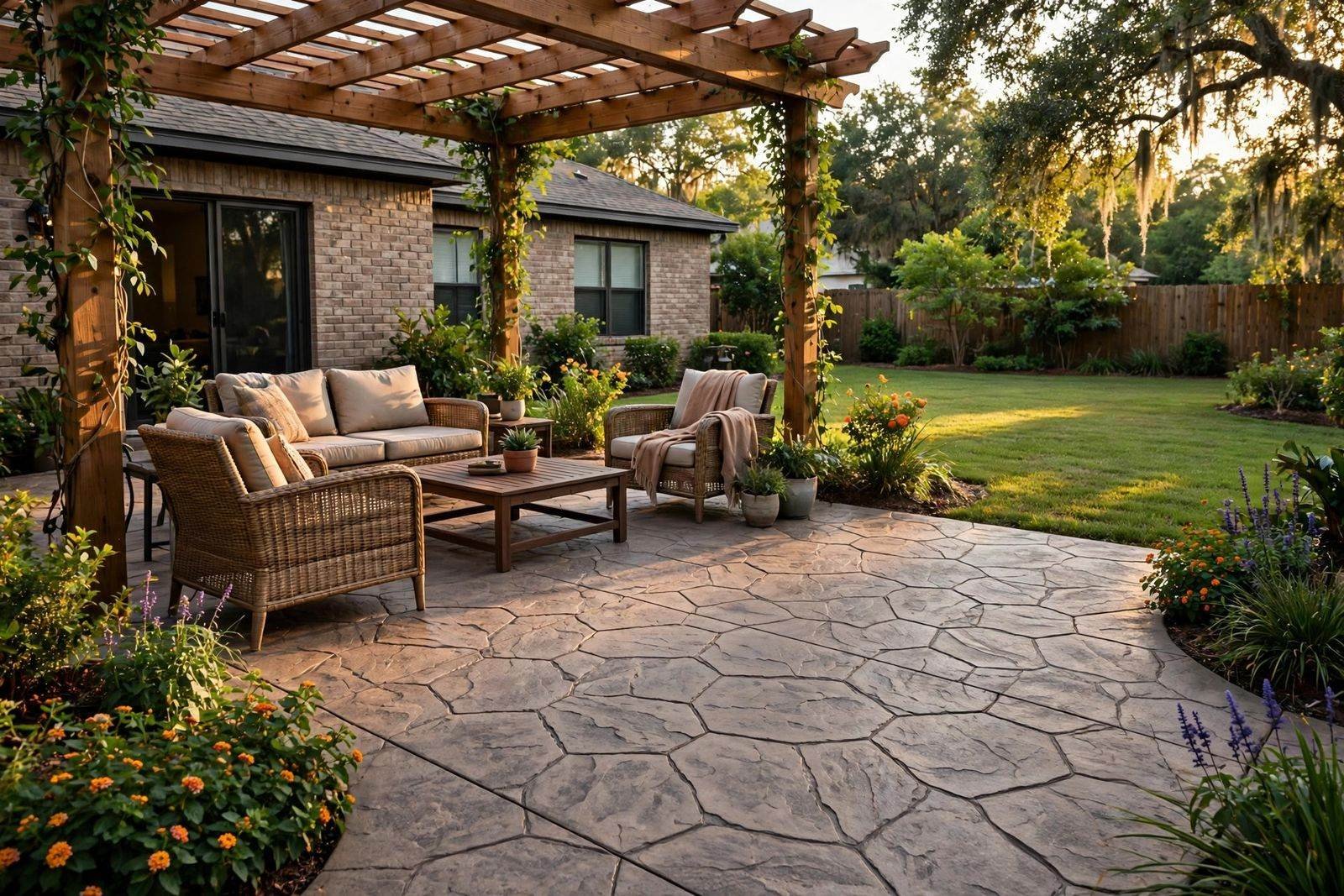
Stamped concrete patio cost by size in Houston
A typical 16×20 stamped patio (320 square feet) in Houston costs about $2,560 to $8,000, with a mid-range pattern and single color usually landing near $4,000–$5,000.
| Patio size | Square feet | Typical Houston cost (stamped) | Notes |
|---|---|---|---|
| 10 × 10 | 100 | $800 – $2,500 | Small jobs carry higher per-sq-ft rates |
| 12 × 12 | 144 | $1,150 – $3,600 | Grill-pad and bistro size |
| 15 × 15 | 225 | $1,800 – $5,625 | Fits dining set plus walkway |
| 16 × 20 | 320 | $2,560 – $8,000 | Most common family patio |
| 20 × 20 | 400 | $3,200 – $10,000 | Outdoor kitchen territory |
| Pool deck surround | 500+ | $5,000 – $15,000+ | Non-slip sealer and drainage critical |
Estimates compiled October 2026 from Angi Houston stamped concrete data (average project $4,461; typical range $2,778–$6,144), HomeGuide pricing and Houston contractor quotes. Prices assume a 3.5–4 inch reinforced pour on a compacted base.
Per-square-foot pricing makes small patios look deceptively cheap and large ones deceptively expensive. Under about 150 square feet, the crew, forming and concrete-delivery minimums dominate, so the effective rate climbs toward the top of the range. Above 300 square feet, those fixed costs spread out and the rate falls — unless the design grows more complex. Price your exact dimensions in the CostSlab patio cost calculator, which separates plain, basic stamped and premium stamped rates.
What a stamped patio quote pays for
On a stamped job, the concrete itself is only about a third of the price; stamping labor, color, release agents and sealer make up most of the rest.
| Cost component | Typical cost | What it covers |
|---|---|---|
| Concrete, base and reinforcement | $4 – $7 per sq ft | Ready-mix, compacted base, rebar/mesh, forms |
| Stamping labor and patterns | $2 – $6 per sq ft | Stamp mats, skilled timing-critical finishing |
| Color (integral + release) | $1 – $4 per sq ft | Base color plus contrasting release/antiquing |
| Borders and second patterns | $2 – $5 per sq ft extra on those areas | Contrasting bands, soldier-course edges, medallions |
| Sealer (initial coat) | Usually included; $1 – $2 per sq ft if itemized | UV-protective sealer, non-slip additive where specified |
| Site prep and access | Varies; hand-carry adds labor | Excavation, grading, drainage slope, tight-gate work |
Stamping is skilled, time-critical work: the crew has one window — while the concrete is plastic but firm — to impress every mat cleanly across the whole slab. That is why stamped work is priced on crew experience as much as materials, and why a quote far below the range usually means a thinner slab, a single fast color pass, or sealer quietly left as an "extra." Ask for the sealer and non-slip additive to be named on the quote.
Patio surface comparison: stamped vs plain, pavers and stone
Stamped concrete sits in the middle of the patio market: more character than plain concrete, about half the cost of flagstone, and cheaper to install than quality pavers.
| Surface | Installed cost / sq ft | Lifespan | Best for |
|---|---|---|---|
| Plain concrete (broom) | $6 – $13 | 30–50 years | Budget patios, utility areas |
| Stamped concrete — basic | $8 – $15 | 25–30+ years | Stone look, one pattern and color |
| Stamped concrete — premium | $15 – $25 | 25–30+ years | Multi-color, borders, custom designs |
| Exposed aggregate | $7 – $18 | 30+ years | Slip-resistant pool surrounds |
| Concrete pavers | $10 – $25 | 25–35 years | Repairable surface on moving clay |
| Natural stone / flagstone | $20 – $35 | 40–50 years | Premium permanent outdoor rooms |
The Houston-specific trade-off is soil movement. A monolithic stamped slab moves as one piece on clay; when it cracks, the crack crosses the pattern and is hard to hide. Pavers move as individual units and can be lifted, re-leveled and relaid after soil shifts — a genuine advantage in Fort Bend clay, paid for with higher install cost and joint maintenance (sand, weeds, fire ants). Many Houston homeowners split the difference: stamped concrete for the main patio, pavers for pathways and borders. If you are also replacing the driveway, the same patterns carry through — see the finish table in our Houston driveway cost guide.
Houston factors that move a stamped patio price
Base, drainage and sun: a Houston patio fails from water underneath or UV on top, so both ends of the job show up in a good quote.
Clay soil and the base
Patios sit on the same expansive clay as driveways, but with thinner slabs (3.5–4 inches) they have less mass to resist movement. A compacted gravel base, reinforcement, and control joints aligned with the stamp pattern are what keep a decorative surface from cracking through its design. Skipping base depth to win a bid is the most expensive saving in this trade.
Drainage and Gulf rain
A patio must slope away from the house — about a quarter inch per foot is the working rule — so Houston's downpours sheet off instead of pooling against the slab edge or the home's foundation. Low backyards in Richmond and Missouri City sometimes need a French drain or channel drain priced into the job. If a quote has no drainage line and your yard holds water after storms, ask why not.
UV, heat and sealer
Texas sun is the slow tax on stamped work: UV breaks down sealer and fades color, which is why resealing every 2–3 years at $2–$4 per square foot belongs in your budget from day one, not as a surprise. Lighter colors stay cooler underfoot for barefoot and pool use; dark charcoal patterns can be uncomfortable in August. A quality UV-stable sealer with a non-slip additive is standard for pool decks and strongly advised anywhere the surface gets wet.
HOA and access in master-planned suburbs
Backyard projects in Katy, Sugar Land and Cinco Ranch commonly need HOA architectural approval, and lot-line setback rules can limit patio size. Access matters to price too: if the only route to the backyard is a 4-foot gate, every yard of concrete is wheelbarrowed or pumped, adding labor that a wide side yard avoids. Mention gate width and any pool equipment or trees in the pour path when you request quotes.
How to save money on a stamped patio
Pattern discipline saves the most: one pattern, one base color and a contrasting border reads as premium design at a basic-pattern price.
- Use one pattern and let the border do the decorating. A simple ashlar or cobble field with a contrasting border band delivers most of the visual effect for far less than a multi-pattern design.
- Go bigger in one pour. If a walkway or grill pad is likely within two years, pour it now — one mobilization, one delivery, one stamping session.
- Choose integral color over surface stains. Color through the slab hides wear and chips far better, and avoids a separate staining step.
- Pour in the cooler season. Fall and winter crews have open schedules and the concrete cures more forgivingly than in August heat.
- Plan the reseal, don't skip it. Budgeting $2–$4 per sq ft every 2–3 years protects the color you paid for; a faded, unsealed patio costs more to restore than to maintain.
- Keep the shape simple. Rectangles stamp efficiently; curves, steps and medallions are hand-work and priced like it.
- Confirm the slab spec before the pattern. If budget forces a choice, spend on base and thickness first — you can enhance color later, but you cannot retrofit a base.
DIY stamped patio vs hiring a pro
Stamped concrete is the least forgiving DIY pour in residential work: the entire slab must be stamped inside a single curing window, with rented mats and a crew-sized effort.
Homeowners successfully pour small plain patios and walkways; stamping changes the math. The pattern must be impressed evenly, in sequence, before the surface hardens — on a 300-square-foot patio that is a race even for professionals. A mistimed section cannot be patched invisibly, and rental stamp mats plus a release agent add real cost to the DIY column. A sensible hybrid: build your own forms, excavate and lay the base (slow, correctable work), then hire a finishing crew for pour day. You save on prep labor while the irreversible hour belongs to people who have done it a hundred times. For plain-slab projects where DIY is more realistic, our Texas slab cost guide covers sizes and specs in detail.
How to hire a stamped concrete contractor in Houston
For decorative work, the portfolio is the qualification: hire the crew whose stamped work you have stood on, in your soil, at least two summers old.
- Ask to see stamped work that is 2+ years old, not fresh — color retention and joint behavior tell the truth.
- Ask: "What is the slab spec — thickness, base depth, reinforcement?" Decorative price over a weak slab is wasted money.
- Ask which sealer is included, whether non-slip additive is in the final coat, and the reseal interval they recommend.
- Ask how the pattern handles control joints — joints should be cut into the pattern lines, not across them.
- Get pattern, colors (base and release) and border design named in the written quote, with a color sample approved before pour day.
- Ask who stamps: the contractor's own crew or a subcontracted finishing crew, and how many stamped jobs they complete a year.
- Confirm HOA approval handling for master-planned suburbs, and the rain-reschedule policy for pour day.
When you are ready, build a quote request for your patio project with your size and suburb, and check your neighborhood's pricing first in the Houston suburb price index.
Stamped patio maintenance and lifespan
With resealing every 2–3 years, a stamped patio in Houston lasts 25–30 years or more; without it, color fades and the surface wears within a decade.
Maintenance is light but non-negotiable: sweep grit that grinds the sealer, rinse spills, and keep metal furniture fitted with pads. The reseal cycle is the real discipline — when water stops beading and color looks flat, the sealer is due. Address drainage problems promptly: soil that washes out from under a patio edge (common after Gulf storms) creates voids that crack slabs from below. Hairline cracks that follow pattern lines are usually cosmetic; cracks that offset or widen follow the same soil-movement logic as driveways and deserve a professional assessment.
Last updated: October 2026 · Sources: Angi Houston stamped concrete cost data (average project $4,461; typical range $2,778–$6,144; $8–$25 per sq ft), HomeGuide pricing, and Houston-area contractor quotes. All prices are estimates in USD; your written quote governs.