Quick Answer
An epoxy garage floor in Houston, TX costs $1,480 to $5,920 for a two-car garage in 2026 — about $3 to $9.50 per square foot depending on the system. Local specialists in the Katy area quote many standard two-car garages from about $1,400, because prep and system choice matter more than brand name.
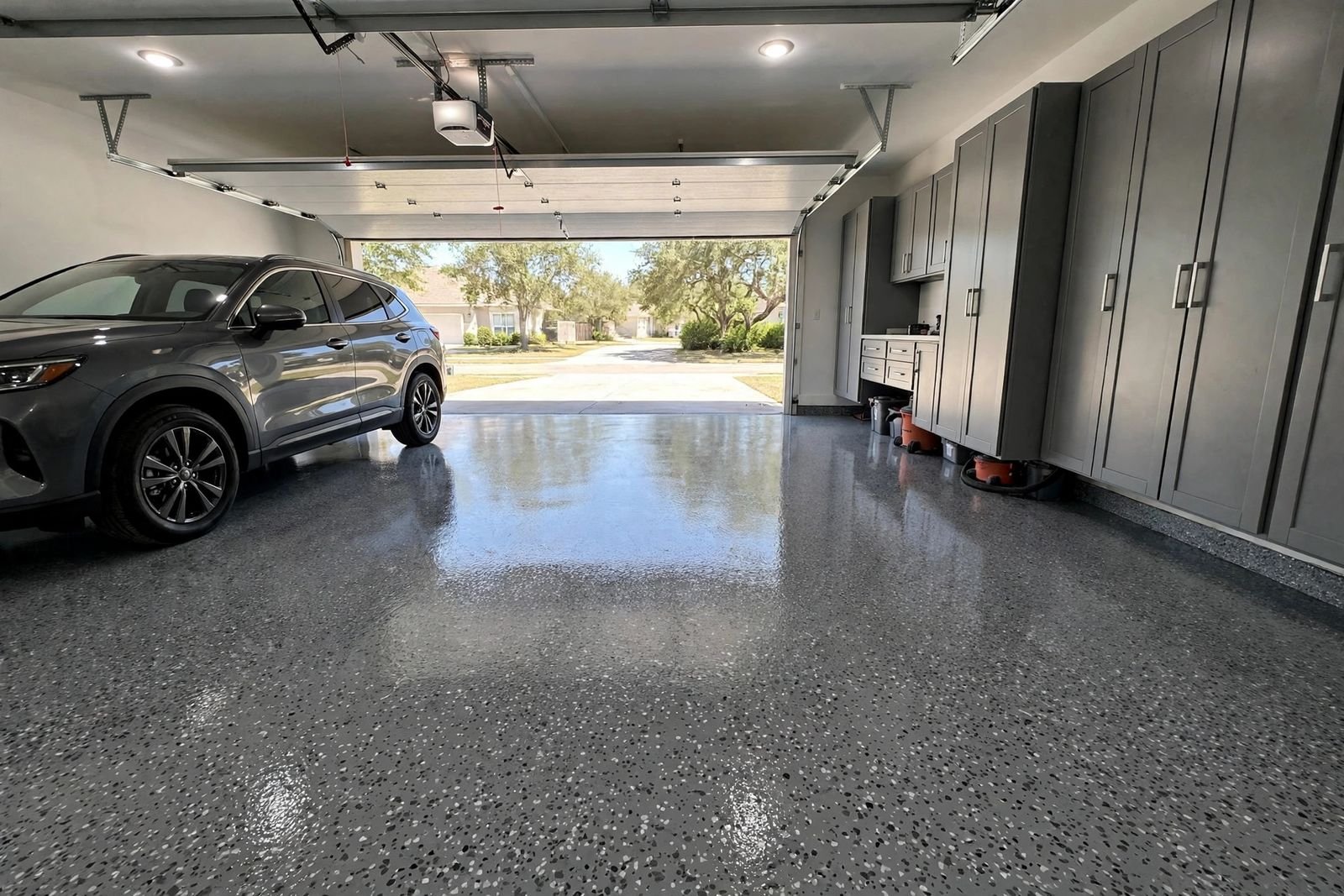
Epoxy garage floor cost by garage size in Houston
A standard two-car Houston garage (400–500 square feet) is the benchmark job: $1,480–$5,920 at published rates, with most full-flake professional installs landing between $1,800 and $3,200.
| Garage size | Approx. sq ft | Typical Houston cost | Notes |
|---|---|---|---|
| 1-car garage | ~250 | $740 – $2,960 | Published Houston range |
| 2-car garage | 400–500 | $1,480 – $5,920 | Local Katy specialists from ≈ $1,400 |
| 2-car, tandem/extended | 500–600 | $1,700 – $2,600 | Common in Katy and Fulshear builds |
| 3-car garage | 600–750 | $2,220 – $8,880 | Workshop areas priced extra |
| 3-car + workshop | 700–950 | $2,400 – $3,400 | Typical specialist quote band |
Estimates compiled October 2026 from Angi Houston epoxy cost data, HomeGuide pricing and Katy-area specialist price lists. Very small or damaged floors cost more per square foot; very large clean floors cost less.
Notice the wide spread on the benchmark job. A $1,480 quote and a $5,920 quote are rarely for the same floor: the low end is a solid-color epoxy on a clean, newer slab; the high end is a metallic or premium polyaspartic system on an older slab that needs crack repair, oil remediation and a moisture barrier. Comparing quotes without naming the system and the prep scope is how homeowners end up comparing a paint job against a floor. Run your garage size through the CostSlab epoxy cost calculator to see each system priced separately before you call anyone.
What a professional coating quote pays for
In a professional Houston install, roughly half the price is preparation and labor — diamond grinding, crack repair and moisture testing — and half is the coating system itself.
| Cost component | Typical share | What it covers |
|---|---|---|
| Surface preparation | 25–35% of quote | Diamond grinding the full floor, degreasing, dust extraction |
| Repairs | 5–15% | Crack and spall filling, joint repair, old coating removal |
| Moisture control | $0 – $1.50 per sq ft extra | Moisture vapor test; vapor-barrier primer when readings are high |
| Coating system | 35–50% | Primer/base coat, flake or metallic layer, UV-stable topcoat |
| Labor and finish work | Included above | Application crew, stem-wall/cove work, cleanup, walkthrough |
This breakdown explains the market's open secret: the coating in the bucket is a minority of the price. Two installers can use near-identical products and differ by $1,000 because one grinds the floor properly, repairs every crack and tests for moisture, while the other acid-etches and hopes. In Houston's humidity, hope is not a prep method. When you read a very cheap quote, ask which of these lines is missing — one of them always is.
Coating systems compared: epoxy, flake, polyaspartic, metallic
Full flake broadcast with a polyaspartic topcoat is the most popular Houston residential system; solid epoxy is the budget option and metallic is the decorative premium.
| System | Cost / sq ft | Install time | Best for |
|---|---|---|---|
| Solid-color epoxy | $3 – $6 | 2–3 days | Budget refresh, storage and workshop garages |
| Full flake / chip broadcast | $4 – $7 | 1–2 days | Most homes; hides imperfections, excellent grip |
| Polyaspartic (1-day system) | $5.50 – $8 | 1 day | Daily-use garages, Texas sun exposure, fast return |
| Metallic epoxy | $6 – $9.50 | 2–3 days | Show garages and finished hobby spaces; each floor unique |
Chemistry matters in Texas. Standard epoxy is strong but amber-yellows under UV and can soften enough in a hot garage for tires to lift it (hot-tire pickup) if the surface was under-prepped. Polyaspartic and polyurea topcoats cure in hours, stay UV-stable, and are roughly four times harder than a basic epoxy coat — which is why most Houston specialists now default to an epoxy base for adhesion with a polyaspartic topcoat for durability. If a quote simply says "epoxy," ask exactly which products go down in which order. Homeowners combining a coating with a new slab or extension should also read our Texas concrete slab cost guide — coating a slab before it has cured (allow at least 28 days, and test) is a classic cause of failure.
Houston conditions that change an epoxy quote
Moisture vapor from below the slab is the number-one coating killer in Houston — ahead of heat, ahead of product quality.
Moisture and flood-zone slabs
Garages in low-lying Fort Bend neighborhoods and near the Brazos River floodplain — parts of Richmond, Rosenberg, Missouri City and Pecan Grove — sit over clay that stays wet for much of the year. Moisture vapor migrating up through the concrete will blister and peel a coating from underneath, sometimes within months. A professional measures this (a calcium-chloride or in-situ RH test) and adds a vapor-barrier primer when readings exceed about 3 lbs per 1,000 sq ft per 24 hours. If your home flooded in Harvey, Imelda or Beryl, say so: even a slab that looks dry can carry an elevated long-term moisture profile.
Heat, humidity and curing windows
Coatings have application windows — typically the slab and air must sit within a temperature and humidity band, and the concrete surface must be at least 5°F above the dew point. Houston summer afternoons regularly break those conditions, which is why good installers start at dawn and watch a hygrometer, not just a clock. Polyaspartic systems widen the window and cure fast enough to finish in one visit, one reason one-day installs are so common in Katy and Sugar Land.
Slab age and condition
Newer master-planned homes in Cinco Ranch and Fulshear often have clean, lightly worn slabs that need standard grinding only. Older garages in Spring, Pasadena and established Houston neighborhoods may carry decades of oil saturation, tire marks, paint overspray and cracked control joints — each adding grinding passes, degreasing and repair time. A coating is only as sound as the surface under it, which is why honest quotes are written after an inspection, not from a photo.
HOA and neighborhood rules
Many Katy and Sugar Land HOAs restrict street parking of work vehicles, noise hours and equipment left visible overnight. One-day systems sidestep most friction: the crew arrives, completes the floor, and the street is clear the same evening. If your community requires approval for work that changes the floor color visible at the garage threshold, check before booking — approval is usually simple but rarely instant.
How to save money on a garage floor coating
The reliable savings come from scope and timing — clearing the garage yourself, choosing flake over metallic, and booking in the installer's quiet season.
- Empty the garage yourself. Installers charge for moving and storing your contents, or require it done anyway. A rented storage pod for a weekend is cheaper than their labor line.
- Choose full flake over metallic. Flake hides slab flaws, needs less artistic labor, and typically saves $2–$3 per square foot while lasting just as long.
- Skip the vapor barrier only if the test says so. The test is cheap; the primer is not. Paying for a test first can save you a primer you do not need — and skipping both is how floors peel.
- Book in late fall or winter. Houston coating crews are busiest in spring; off-season schedules in November–February are more flexible and sometimes discounted.
- Coat before you move in. New-home garages in Katy and Fulshear are empty and clean — the cheapest possible install conditions, often quoted at the bottom of the range.
- Get stem walls included in writing. Coating the vertical stem wall and apron edge looks finished and prevents the most visible peel line; adding it later costs a second mobilization.
DIY epoxy kits vs a professional install
A big-box DIY kit costs $200–$600 for a two-car garage versus $1,400+ professionally — but the two products are not the same coating, thickness or warranty.
Hardware-store kits are thin, water-based epoxies (often under 5 mils dry) applied over acid etching. Professional systems are 100%-solids coatings laid 20+ mils thick over diamond-ground concrete. In a cool, dry climate a careful DIY job can look decent for years; in Houston, heat, humidity and hot tires expose the difference fast, and kit floors commonly peel or lift within 2–4 years. Removing a failed DIY coating then adds grinding cost to the professional job you end up hiring anyway. If your budget is under $1,000 and the garage is a workshop rather than a showpiece, a kit is a defensible short-term choice — just go in knowing it is a 3-year floor, not a 15-year one. Otherwise, the professional quote is buying prep, thickness and a warranty, not just a shinier surface.
How to hire a garage floor contractor in Houston
Judge an installer by their prep process and moisture policy — those two answers predict the floor's life better than any product brochure.
- Ask: "Do you diamond-grind, or acid-etch?" Grinding is the professional standard; etching alone is a red flag.
- Ask: "Do you test moisture, and what happens if readings are high?" The right answer names a test and a vapor-barrier option priced in writing.
- Ask: "What exactly is the system — primer, base coat, flake, topcoat — and which products?" Get product names on the quote.
- Ask how cracks, spalls and control joints are handled, and whether stem walls are included.
- Ask about return-to-service times — foot traffic, vehicle traffic, heavy items — in writing.
- Confirm the warranty covers peeling and delamination (adhesion failure), not just product defects, and for how long.
- Check recent installs in your suburb — our Houston suburb price index shows what neighbors typically pay, so you can spot an outlier quote in either direction.
Ready for real numbers? Build a quote request for your garage floor with your garage size and suburb, or compare project types first in our Houston driveway cost guide if you are planning a combined concrete project.
Garage floor maintenance and lifespan
A professionally prepared coating lasts 10–20 years in Houston with basic care: sweep grit, clean spills promptly, and avoid dragging sharp metal across the topcoat.
Day to day, a coated floor needs less care than bare concrete: dust and road grit sweep off, oil and chemicals wipe up instead of staining, and an occasional mop with a pH-neutral cleaner restores the shine. Use felt pads under heavy tool chests, and a mat where motorcycle kickstands or floor jacks land. Recoating a worn topcoat — typically at year 8–12 on a hard-used floor — costs a fraction of the original job because the base system stays in place. The failures to watch for are peeling at the door line (moisture or UV at the threshold) and patchy blistering; both are warranty conversations to have early, while the cause is still diagnosable.
Last updated: October 2026 · Sources: Angi Houston epoxy flooring cost data (two-car garage $1,480–$5,920), HomeGuide pricing, and Katy-area specialist price lists (standard two-car garages from ≈ $1,400). All prices are estimates in USD; your written quote governs.