Quick Answer
A concrete slab in Texas costs about $7 to $13 per square foot installed in 2026. A standard 600 sq ft garage slab runs roughly $4,200 to $7,800 total, depending on thickness, reinforcement and site prep. On Houston's Gulf Coast, expansive clay soil makes base preparation and rebar the lines that matter most.
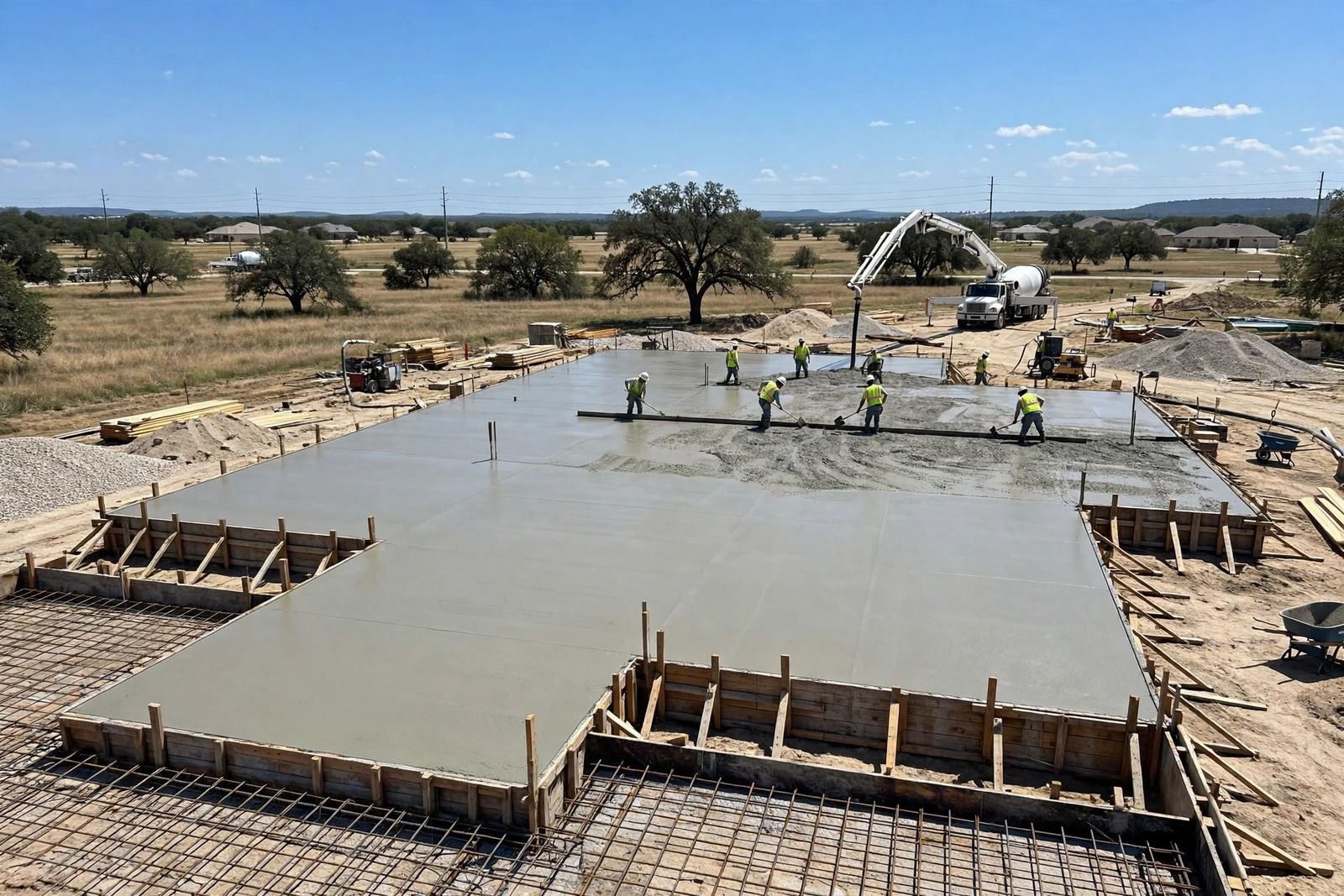
Concrete slab cost by size and type in Texas
A 20×30 garage slab (600 sq ft) at $7–$13 per square foot is the benchmark Texas job; small utility pads cost more per foot, heavy RV slabs cost more per inch.
| Slab project | Typical size | Cost / sq ft | Typical total |
|---|---|---|---|
| Shed / utility slab (4 in) | 10 × 12 (120 sq ft) | $6 – $10 | $720 – $1,200 |
| Hot tub / AC equipment pad | 8 × 8 (64 sq ft) | $8 – $14 | $510 – $900 |
| Workshop floor extension | 12 × 20 (240 sq ft) | $6 – $12 | $1,440 – $2,880 |
| Garage slab (4–5 in, reinforced) | 20 × 30 (600 sq ft) | $7 – $13 | $4,200 – $7,800 |
| RV pad / heavy slab (6 in) | 12 × 40 (480 sq ft) | $9 – $15 | $4,320 – $7,200 |
| Metal building / shop slab | 30 × 40 (1,200 sq ft) | $7 – $13 | $8,400 – $15,600 |
Estimates compiled October 2026 from published Texas pricing (a standard 600 sq ft plain slab in the Houston–Dallas range totals $4,200–$7,800), HomeGuide data and Houston-area contractor quotes. Totals assume a compacted base and standard finish; foundations for occupied structures are engineered work and priced separately.
Two warnings about per-square-foot shopping for slabs. First, small pads: a 64-square-foot equipment pad at "$13 a foot" is not a rip-off — the truck, forms and crew minimums are spread over very few feet. Second, foundations: a slab-on-grade foundation for a house or barndominium is an engineered system with beams, plumbing rough-in and inspections, and is not comparable to the utility and garage slabs priced here. If your project supports a building people will live in, get engineered plans and foundation quotes, not patio math. Price your own slab size in the CostSlab slab calculator, which separates utility, garage and RV specs.
What a Texas slab quote pays for
Materials and labor split a slab quote roughly in half; base excavation, reinforcement upgrades and any demolition are the lines that separate quotes.
| Cost component | Typical cost | What it covers |
|---|---|---|
| Concrete (ready-mix) | Scales with thickness | 4 in = 25% less volume than 5 in; 6 in = 50% more than 4 in |
| Base excavation and gravel | $1 – $2 per sq ft | Dig-out, 4+ inches of compacted base, grading and moisture |
| Reinforcement | $0.50 – $1.50 per sq ft | Rebar grid or welded wire mesh, chairs, tie wire |
| Forms and finishing labor | Balance of quote | Formwork, pour, screed, broom or trowel finish, joint cutting |
| Old slab demolition | $1.50 – $3.50 per sq ft | Breaking, haul-off and disposal; reinforced slabs cost more |
| Permits (where required) | $70 – $300 | City permits and inspections, varies by city and scope |
| Concrete pump (if needed) | $150+ per hour is common | When a mixer truck cannot reach the pour location |
Thickness deserves one honest paragraph because it is the most upsold and most undersold line at once. Going from 4 to 5 inches uses 25% more concrete, and 4 to 6 inches uses 50% more — but the total quote rises only about 12% and 25% respectively, because labor and base barely change. That makes a thickness upgrade cheap insurance for a slab that will carry trucks, lifts or an RV. The reverse is also true: paying 6-inch money for a shed pad is wasted budget. Buy thickness for the load you actually have.
Slab types compared: thickness and reinforcement by job
Match the spec to the load: 4 inches for sheds and foot traffic, 4–6 inches reinforced for garages, 6 inches with rebar for RVs and heavy equipment.
| Slab type | Thickness | Reinforcement | Cost / sq ft |
|---|---|---|---|
| Utility / shed slab | 4 in | Wire mesh | $6 – $10 |
| Patio / walkway slab | 3.5 – 4 in | Mesh or light rebar | $6 – $12 |
| Garage slab | 4 – 5 in | Rebar grid recommended | $7 – $13 |
| RV / heavy-duty slab | 6 in | Rebar grid, closer spacing | $9 – $15 |
| Shop / metal building slab | 4 – 6 in | Per plan; often engineered | $7 – $13 |
Reinforcement is not there to stop cracks — concrete cracks; that is normal and expected. Rebar and mesh hold those cracks tight and level so they stay hairlines instead of becoming offsets and trip edges. On Texas clay, where the ground itself moves seasonally, that distinction is the difference between a slab that looks aged at year ten and one that is being quoted for replacement. If a slab will later be coated, the spec conversation continues into surface preparation — see our epoxy garage floor cost guide for how slab condition drives coating prices.
Texas and Houston factors that move a slab price
On the Gulf Coast, a slab is a soil-management project with concrete on top: clay movement, drainage and summer curing decide the outcome.
Expansive clay and base depth
Houston and much of the Texas Gulf Coast sit on clay that swells when wet and shrinks when dry. The defense is a base: excavate the topsoil, lay 4 or more inches of compacted gravel or sand, grade it, and moisten it before the pour so the slab starts on stable, uniform ground. Quotes that pour on scraped dirt are cheaper for exactly one season. In parts of Fort Bend County and near the Brazos, deeper bases or lime-treated subgrade are sometimes specified.
Drainage, floodplain and easements
A slab changes how water moves across a lot. It must shed water away from buildings, must not concentrate runoff onto a neighbor, and in mapped floodplains it may trigger elevation and permit requirements — a real consideration in low-lying Richmond, Rosenberg and Missouri City lots. Utility easements are the other Texas trap: a slab poured over an easement can be ordered removed at your expense when the utility needs access. Check your survey before forming, not after.
Summer heat and curing
Texas summer pours are scheduled at dawn for a reason: hot, windy conditions dry the surface faster than it can cure, causing plastic-shrinkage cracks within hours. Good crews use evaporation retarders, cure compounds or wet curing, and will not pour ahead of a Gulf storm. If a contractor is indifferent to a 100°F forecast or an afternoon thunderstorm, that indifference will be cast into your slab permanently.
Permits and city rules
Permit rules are city-by-city in Texas. Houston commonly exempts small detached accessory slabs, while structural slabs, work in the right-of-way, and anything in a floodplain require permits and inspections, typically $70–$300. Suburban cities and HOAs add their own layer: Katy and Sugar Land communities often require architectural approval for new slabs and outbuildings. A contractor who says "nobody gets permits" is telling you who will own the problem if the city disagrees — you.
How to save money on a concrete slab in Texas
The biggest slab savings come from right-sizing the spec, timing the pour, and combining work into a single mobilization.
- Spec for the real load. A 4-inch mesh slab is correct for a shed; do not buy RV thickness for lawn equipment — and do not park an RV on a shed spec either.
- Pour once, pour everything. Slab, walkway and equipment pad in a single mobilization share delivery and crew minimums and cut the per-foot rate across all of them.
- Keep it rectangular. Straight forms are fast; curves, steps and multiple levels are forming labor priced by the hour.
- Schedule in the cooler months. Fall through early spring brings open crew schedules and easier curing conditions in Texas.
- Prepare access yourself. Clearing the area, removing fencing panels and confirming truck or pump access avoids day-of change orders.
- Do not skimp on the base to save $1 a foot. Base and reinforcement are the cheapest longevity in the entire quote; cutting them converts savings into a replacement bill.
- Compare quotes on the same spec sheet. Thickness, base depth, reinforcement type and finish — if one bid omits a line, it is not cheaper, it is smaller.
DIY slab vs hiring a Texas pro
A slab under about 100 square feet is a realistic DIY project; a garage or RV slab is a truck, a crew and a four-hour race against curing concrete.
Bagged concrete math decides small jobs: a 10×10 pad at 4 inches needs roughly 60–70 eighty-pound bags — heavy but weekend-feasible with a rented mixer, and genuinely cheaper than a pro's minimum charge. Scale up and the math inverts: a 600 sq ft garage slab is about 7.5 cubic yards, delivered by truck, that must be placed and finished before it sets, on a base that took a day to build correctly. Most homeowners land in the hybrid zone: DIY the excavation and base for a mid-size pad if you are confident in your grading, then hire the pour and finish. And if the slab supports a vehicle, a building or resale value, the pro's warranty and the permit paper trail are part of what you are buying. Our driveway cost guide walks through the same decision for the largest slab most homes ever pour.
How to hire a slab contractor in Texas
Hire on the written spec — base depth, thickness, reinforcement, joints — because a slab's quality is invisible the day after the pour and obvious at year five.
- Ask: "How deep do you excavate, and how much compacted base is included?" Anything under 4 inches on Houston clay needs a good explanation.
- Ask: "Rebar or mesh, at what spacing, and is it chaired up into the slab?" Reinforcement lying on the ground does almost nothing.
- Ask how control joints are laid out and when they are cut — same day is the standard answer.
- Ask whether the price includes permits, inspections and any required HOA paperwork for your suburb.
- Ask what happens with rain or extreme heat on pour day; rescheduling is the professional answer.
- Get the finish specified (broom, smooth trowel, exposed) and the cure method in writing.
- Verify with our Houston suburb price index whether your area runs above or below baseline before judging a quote high or low.
Ready for exact numbers? Build a quote request for your slab project — size, suburb and intended use are all it takes.
Slab maintenance and lifespan in Texas
A correctly built Texas slab lasts 30–50 years with almost no maintenance beyond drainage: keep water moving away and soil levels stable at the edges.
Slab care is mostly water management. Keep gutters and downspouts discharging away from the slab, maintain soil or landscaping against the edges so the base does not erode or dry unevenly, and in long Houston droughts, light, even watering of the soil around large slabs is a recognized way to limit clay shrinkage at the perimeter. Seal expansion joints when the filler fails. Hairline cracks are normal and cosmetic; cracks that widen season after season, panels that rock, or doors on slab-built structures that start sticking are movement signals worth a foundation professional's opinion. Coated or decorative slabs add one duty: maintain the sealer or topcoat on the schedule in our patio and epoxy guides.
Last updated: October 2026 · Sources: published Texas slab pricing (600 sq ft plain slab, Houston–Dallas range $4,200–$7,800), Angi Houston cost guides, HomeGuide pricing data, and Houston-area contractor quotes. All prices are estimates in USD; your written quote governs.